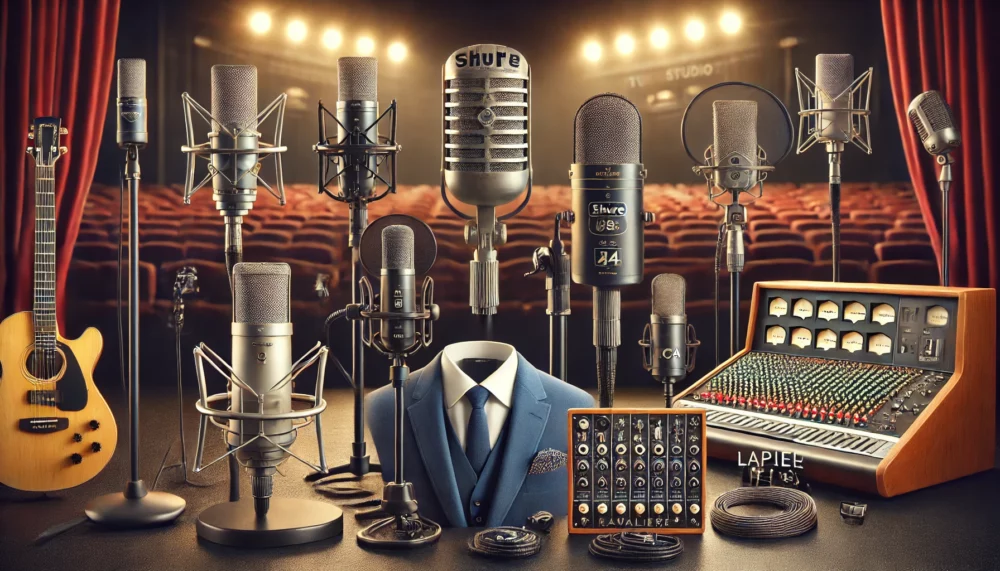
Recording and transmitting sound is one of the most critical elements for today’s modern stage performances and television broadcasting. Furthermore, as a fundamental component of this process, microphones ensure that sound is transmitted with high quality. However, microphones used in stage and television studios possess much more complex design features and advanced technologies than ordinary microphones. In this article, microphone types, brands, technologies, advantages, and disadvantages will be discussed in detail.
Microphone Types and Usage Areas
Microphones are divided into different categories based on their method of converting sound into electrical signals, their polar pattern, and their intended use. Additionally, the most preferred microphone types in stage and television studios are as follows:
1. Dynamic Microphones
Dynamic microphones are widely used in stage performances due to their robust construction and resistance to high sound pressure levels. They are particularly ideal for vocal performances and powerful instrument sounds.
- Technical Specifications: They specifically use a moving coil system and convert sound waves into electrical signals within a magnetic field.
- Advantages: They are also durable, suitable for outdoor conditions, and resistant to high volume levels.
- Disadvantages: Their frequency response is particularly limited, and they may struggle to capture fine details due to low sensitivity.
2. Condenser Microphones
Condenser microphones are frequently preferred in television studios and recording environments for their wide frequency response and high sensitivity. These microphones perform exceptionally well, especially in vocal recordings and acoustic instruments.
- Technical Specifications: They also feature a thin diaphragm and a backplate behind it. The vibrations of the diaphragm are converted into electrical signals through changes in capacitance.
- Advantages: Particularly high sensitivity, wide frequency range, and natural sound reproduction.
- Disadvantages: They also require an external power source (phantom power) and are physically more delicate.
3. Ribbon Microphones
Ribbon microphones are sensitive microphones used to capture natural and warm tones of sound. Moreover, they are generally ideal for interviews and film shoots in television studios.
- Technical Specifications: Specifically, a metal ribbon vibrates within a magnetic field to convert sound waves into electrical signals.
- Advantages: Also features a smooth high-frequency response and natural sound reproduction.
- Disadvantages: They are particularly sensitive, cannot withstand high sound pressure levels, and can be easily damaged.
4. Lavalier Microphones (Lapel Microphones)
Lavalier microphones are preferred in television broadcasts and on stage when speakers need to keep their hands free. They also stand out for their small size and portability.
- Technical Specifications: They also generally have a condenser-type microphone capsule and can be used wired or wireless.
- Advantages: They are particularly easy to use, can be placed invisibly, and provide freedom of movement.
- Disadvantages: They are also sensitive to noise, and sound quality may be lower compared to other microphone types.
5. Shotgun Microphones
Shotgun microphones are used in television studios and behind-the-scenes shoots. Because they have a narrow polar pattern, they can focus specifically on a particular source.
- Technical Specifications: They have a very narrow polar pattern and usually operate with a supercardioid or hypercardioid orientation.
- Advantages: They can capture sound from a long distance and reduce background noise.
- Disadvantages: They struggle to capture sounds coming from the sides, and their use requires expertise.
Leading Microphone Brands
The quality of microphones used in stage and television studios can vary greatly depending on their brand. Here are some brands popular among professional users:
- Shure: Known for its durable construction and ideal design for stage performances. Featured models: Shure SM58, Shure KSM44.
- Sennheiser: Offers high sound quality and versatile usage possibilities. Featured models: Sennheiser e945, Sennheiser MKH 416.
- Neumann: An excellent choice for studio recording, Neumann microphones excel at capturing the natural tone of sound. Featured model: Neumann U87.
- Audio-Technica: Offers affordable and high-quality microphones. Featured model: Audio-Technica AT2020.
- AKG: Versatile use and superior sound quality. Featured model: AKG C414.
- Rode: Offers affordable solutions for both stage and studio use. Featured models: Rode NT1-A, Rode VideoMic Pro.
Microphone Technologies
Technologies used in modern microphones are constantly evolving to increase sound quality and ease of use. Here are some of these technologies:
- Wireless Microphone Systems: Provide freedom of movement in stage performances and offer low latency.
- Digital Microphones: Offer higher sound quality compared to analog microphones and provide noise reduction thanks to digital signal processing (DSP) technology.
- Noise Cancellation Technology: Especially important for clean sound recording in television studios.
Conclusion
Microphones used in stage and television studios, with their different types, brands, and technologies, are indispensable for professional sound recording and performance. Furthermore, the correct choice of microphone directly affects the success of the event or recording. With the continuous development of technology, microphones are becoming even more sophisticated. Therefore, factors such as intended use, environmental conditions, and budget should be considered when selecting a microphone.
You can review our sound system rental service, including conference and stage microphones.
Correct sound capture is the first step in turning reality into a work of art. Microphones act as a bridge that preserves the soul of the sound.
Ray Dolby · Audio Engineer, Founder of Dolby Laboratories