From HD to 8K: The Evolution of Resolution Technologies and Details of Pixel Technology
In display technologies, resolution is one of the most crucial factors determining how much detail a screen or image can show. Resolution is also expressed by the total number of pixels in an image. A pixel is the smallest building block of digital images and forms the foundation of resolution technologies. The technological evolution from HD to 8K has been shaped by increasing pixel density and improvements in image quality. This article will thoroughly examine the pixel structure, technical details, and applications of resolution technologies.
1. What are Resolution and Pixels?
Resolution refers to the number of horizontal and vertical pixels in an image. A pixel, on the other hand, is the smallest component of a digital image. The resolution of a screen or image is determined by the total number of pixels. More pixels mean more detail and clarity.
- Pixel: An abbreviation of “Picture Element,” it is the smallest unit that forms an image.
- Resolution Formats: Resolution is typically expressed by the number of horizontal and vertical pixels (e.g., 1920×1080).
- Pixel Density (PPI): This refers to the number of pixels per inch. Higher PPI provides sharper images.
2. Historical Development of Resolution Technologies
Resolution technologies have advanced in parallel with developments in television, cinema, and display technologies. Here is the historical development of these technologies:
2.1 SD (Standard Definition)
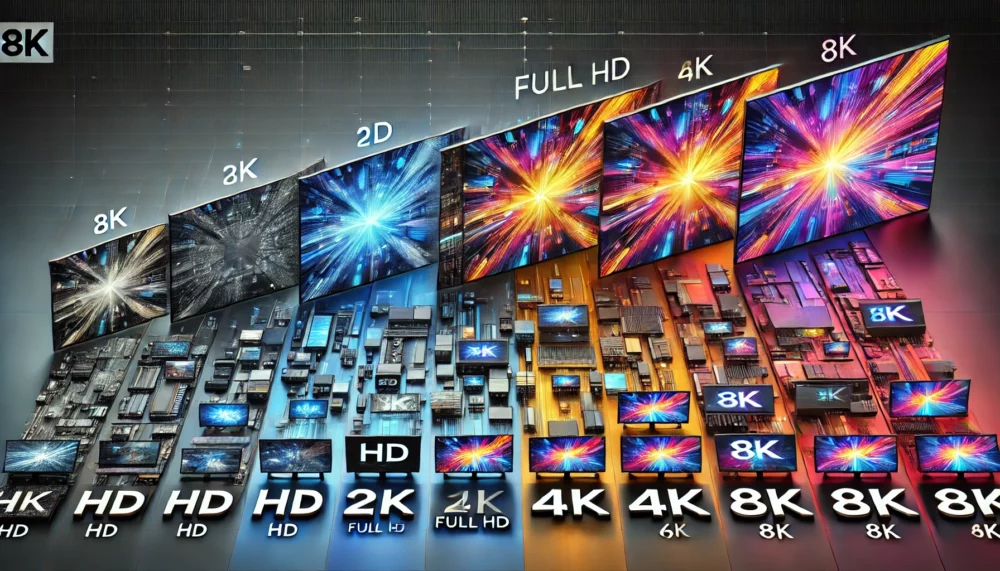
SD resolution, known as 480p, consists of 720×480 pixels. It is one of the earliest standards for television broadcasting.
2.2 HD (High Definition)
HD resolution consists of 1280×720 pixels and refers to the “high-definition” image standard. The increase in pixel density has provided clearer and sharper images.
2.3 Full HD (1080p)
Full HD offers 1920×1080 pixel resolution. It has become the standard for Blu-ray movies, video games, and modern television broadcasting.
2.4 4K (Ultra HD)
4K resolution consists of 3840×2160 pixels. This means four times more pixels compared to Full HD. It is ideal for larger screens and cinema films.
2.5 8K
8K resolution consists of 7680×4320 pixels. It can capture even the finest details perceptible to the human eye. It has begun to be used especially in professional productions.
3. Technical Details of Pixel Technology
Pixel technology forms the foundation of resolution technologies. Each pixel consists of three primary colors (RGB: red, green, blue), and images are created by combining these colors.
3.1 Pixel Structure
- Subpixel: Each pixel consists of red, green, and blue subpixels.
- Color Depth: This is the number of bits per pixel. Higher color depth offers a wider color range.
- Pixel Density: Pixel density varies according to screen size. Higher pixel density on smaller screens provides sharper images.
3.2 Pixel Density and Image Quality
A screen’s pixel density (PPI) directly affects image quality. For example:
- HD: Having lower pixel density, pixelation can be observed on large screens.
- 4K: Thanks to its higher pixel density, it provides clear images even on large screens.
- 8K: It can display even the finest details perceptible to the human eye.
3.3 Innovations in Pixel Technology
Innovations in pixel technology provide higher resolution and better image quality:
- MicroLED: A technology where each pixel has its own light source.
- OLED: Pixels made from organic materials offer higher contrast and color accuracy.
- Quantum Dot: Provides a wider color gamut and brighter images.
4. Applications of Resolution Technologies
Different resolution levels are used for various purposes across different sectors:
4.1 Cinema and Television
- HD and Full HD: Widely used in television broadcasting.
- 4K and 8K: Preferred for cinema films and premium content.
4.2 Medicine and Science
High resolution provides clearer details in medical imaging and scientific research.
4.3 Education and Virtual Reality
4K and 8K resolution offer more immersive experiences in education and virtual reality applications.
5. Future Resolution Technologies
Resolution technologies will continue to evolve in the future, offering new applications:
- 16K and Beyond: Research and development efforts are targeting even higher resolution standards.
- AI-Powered Image Processing: This will enable the conversion of lower-resolution content to high resolution.
Conclusion
The evolution of resolution technologies, from HD to 8K, has been made possible by advancements in pixel structure. Higher resolution and pixel density offer clearer and more realistic images, creating new opportunities across various sectors. In the future, with further developments in resolution technologies, we will encounter images that push the limits of human perception.
To choose the right LED screen resolution for your event, you can browse our LED screen rental page. To deliver your event to viewers in high resolution, you can also check out our live streaming service page. Additionally, for UHD image standards, you can review the ITU-R BT.2020 recommendation.
To see is the first step to understanding. Higher resolutions push the boundaries of the human eye, creating a new universe of perception.
Carl Sagan · Scientist and Cosmologist